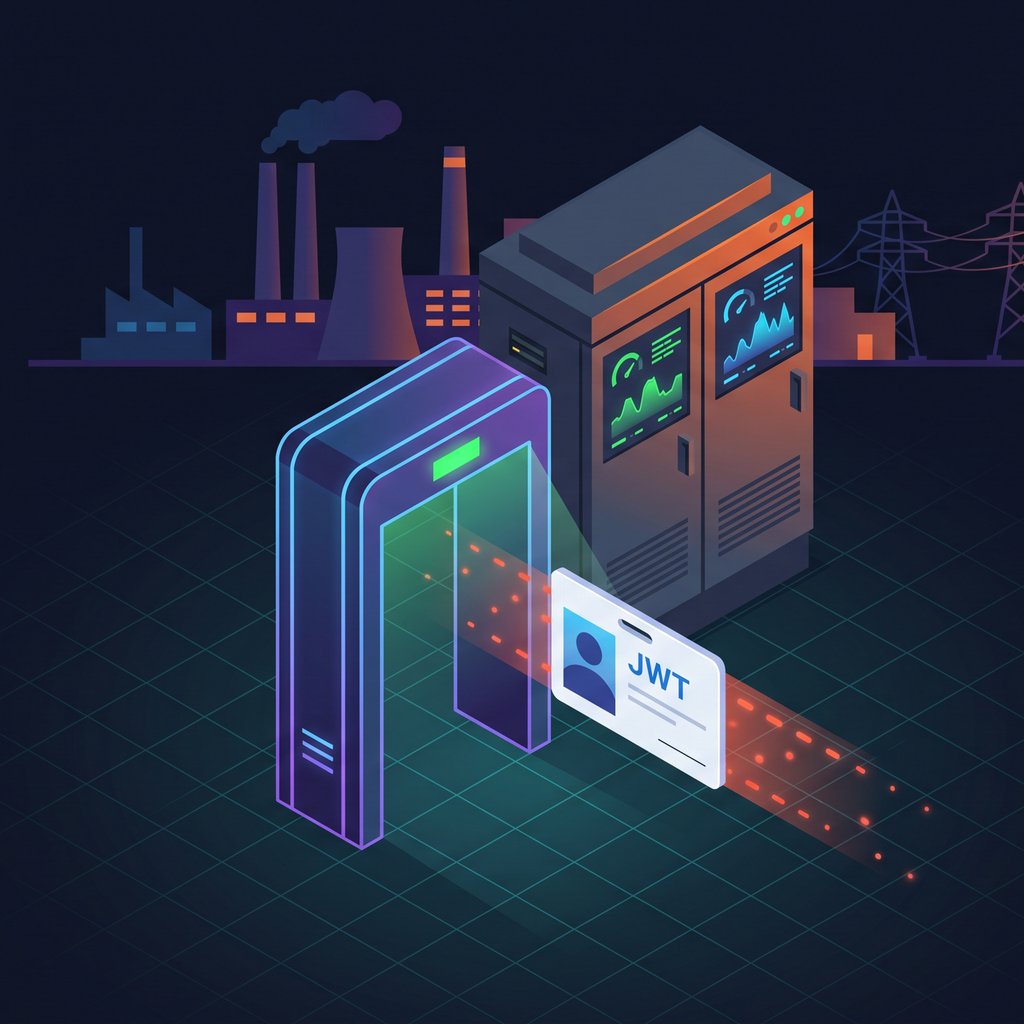
Status, November 17, 2026, 23:55 UTC. CVE-2026-120387 was published today with a CVSS 4.0 score of 10.0. CIRCUTOR's fixed build is PowerStudio SCADA WAVE 24.11.17.0. It is not in CISA KEV and no attacks have been reported, but the researchers' write-up and exploit code have been public on GitHub since August 10, three months before the CVE.
- What it is: PowerStudio SCADA WAVE, CIRCUTOR's energy-monitoring SCADA for Windows, accepts unsigned login tokens. A JWT with its algorithm set to "none" is treated as a valid identity, with whatever role the attacker writes into it, including administrator.
- Who is affected: PowerStudio SCADA WAVE desktop from 24.8.0 up to, but not including, 24.11.17.0. It is common in industrial plants, data centers, hospitals and commercial buildings for power metering and power quality.
- Why it matters: one shared authentication library sits under every PowerStudio microservice, so one bug defeats all of them. The same researchers chain it into command execution as SYSTEM on the SCADA server.
- Do now: upgrade to 24.11.17.0. Until you can, keep ports 8091, 8105, 8089 and 8101 off any network an attacker could reach, and block tokens with
algset tononeat your proxy. Change the defaultadminanduserpasswords if anyone ever left them. - Detection: our CVE Forge feed already carries a Sigma rule for this CVE. More signals below.
What Happened
PowerStudio SCADA WAVE is built as a set of ASP.NET Core microservices (administration, widgets, events, licensing, identity, drivers, analytics). They all load the same authentication setup from a shared library. According to the research published by 0day Rubbish in August, that setup replaces the normal signature check with one that always succeeds, does not require signed tokens, and skips the issuer, audience and signing-key checks. Authentication errors are logged and ignored instead of rejecting the request.
The result is that the product trusts whatever a token says about who is calling. An unauthenticated attacker who can reach a PowerStudio port can claim any role and call any protected endpoint: read configuration and license state, change SCADA settings, stop and start the engine and the microservices, and upload or delete files.
The CVE record, published November 17, describes the same flaw: "The shared JWT validation component accepts the token without verifying a cryptographic signature, allowing the attacker to impersonate another user and access protected functionality with that user's privileges." The assigning CNA scored it CVSS 4.0 10.0 (AV:N/AC:L/AT:N/PR:N/UI:N, high impact on the system and on systems downstream). CISA's SSVC data marks it as automatable, with a proof of concept and total technical impact.
From Login Bypass to SYSTEM
On its own the token bug is an authentication bypass. The researchers published a second finding that turns it into remote code execution. With a forged admin token, an attacker:
- writes a malicious events configuration file into the PowerStudio configuration folder through a path traversal in the widgets file storage API (port 8105), and
- tells the administration service (port 8089) to restart the SCADA engine, which loads the file and runs the command in it as
NT AUTHORITY\SYSTEM.
There is one real limit. The administration service listens only on the server itself (127.0.0.1) by default. The full chain closes from the network only if that port has been exposed: by an operator rebinding it, by a reverse proxy forwarding to it, or by the host firewall letting a trusted segment in. The researchers say so plainly and score the chain 9.8 for that worst case. The widgets service (8105) and the gateway (8091) listen on all interfaces by default, so the authentication bypass alone is reachable in a default install.
The same group also reported a command injection in CIRCUTOR's LineEds energy gateway firmware (24.11.14), in the same event engine's shell action. That is a separate Linux appliance and has no CVE yet that we can find.
| Port | Service | Default binding | Role |
|---|---|---|---|
| 8091 | Reverse proxy gateway | All interfaces | Front door; forwards to the microservices |
| 8105 | PSSWidgets (IIS) | All interfaces | Token bypass; file write in the RCE chain |
| 8089 | PSSAdministrator (HTTPS, runs as SYSTEM) | 127.0.0.1 | Engine stop and start in the RCE chain |
| 8101 | PSSEvents | Per deployment | Protected by the same broken check |
What to Do
- Upgrade to PowerStudio SCADA WAVE 24.11.17.0 or later. That is the fixed build named in the CVE. CIRCUTOR's security page did not list an advisory for it when we checked tonight, so confirm the build with your CIRCUTOR distributor or integrator.
- Take the ports off reachable networks. A SCADA server should not answer from the internet or the corporate LAN. Allow 8091 and 8105 only from the operator workstations that need them, and confirm 8089 is still bound to 127.0.0.1 with no proxy rule forwarding to it.
- Reject unsigned tokens in front of it. If a reverse proxy or WAF sits in front of PowerStudio, drop any request whose bearer token header declares
"alg":"none"or whose signature segment is empty. That is the researchers' own interim control. - Change the default accounts. The research notes seeded
adminanduseraccounts with default passwords. Change them, whatever build you are on. - Treat an exposed server as possibly touched. The exploit has been public since August. If a PowerStudio port was reachable from an untrusted network since then, review the server before trusting it (see below), and rotate the credentials it stores for mail and Telegram alerting.
How to Spot It
- Unsigned tokens. A JWT header that decodes to
{"alg":"none"}starts with the Base64 texteyJhbGciOiJub25l. Any request to a PowerStudio port carrying one is hostile or a test. Proxy, WAF or IIS logs that record theAuthorizationheader will show it; most do not by default, so turn that on for this server. - Engine restarts nobody asked for.
PUTrequests to/api/engines/v1/.../stopor/start, or the PowerStudio engine (PwrStudio.exe) stopping and starting outside a maintenance window. - Configuration written over the web.
POST /api/storage/v1requests with../or encoded traversal in the file name, and changes todefault.xeveinC:\ProgramData\Circutor\PowerStudio Scada\Cfg\. Look inside that file for ashellExecuteaction you did not configure. - The engine starting a shell.
PwrStudio.exeor a PowerStudio service spawningcmd.exe,powershell.exe,rundll32.exeor a download tool. That is the end of the RCE chain, and endpoint telemetry (Sysmon event 1, Windows 4688, or your EDR) catches it even when the web logs do not.
Our CVE Forge feed carries a Sigma rule for CVE-2026-120387 that matches the unsigned-token header in web logs. Like most forge rules it ships disabled: enable it where you collect proxy or web server logs for PowerStudio.
RedEye Assessment
Patch this week, and fix the exposure today. The bug is about as simple as authentication bugs get, it needs no credentials, and working exploit code has been on GitHub for three months, which is longer than most defenders have known the CVE number. What limits the damage is network placement: a PowerStudio server reachable only from its own OT segment is a much smaller problem than one on a flat network or behind a port forward. Energy-monitoring SCADA tends to get installed by electrical contractors rather than IT, so it is often the box nobody remembers putting on the network. Find it first.
Sources: NVD, CVE.org, cve.now, 0day Rubbish research, 0day Rubbish CIRCUTOR findings, CIRCUTOR cybersecurity.
Questions about your exposure?
RedEye Security provides assessments for organizations that need to understand their real risk.
Talk to us